-
Shop
- Advanced Technologies
- AI Skills
- Bathroom
- Best-Sellers
- Car Accessories
- Confidence
- Dating & Social Skills
- Digital Resources
- AI & Technology
- Beauty
- Budgeting & Saving
- Car Buying & Ownership
- Cozy Feast Collection
- Electronics & Technology
- Entrepreneurship & Business Growth
- Financial Education
- Financial Independence
- Financial Mindset & Psychology
- Goal Setting
- Home Styling & Organization
- Kitchen & Recipes
- Leadership
- Mindfulness
- Mindset
- Online Business
- Parenting & Child Development
- Personal Style & Fashion
- Pet Lifestyle & Wellness
- Positive Thinking
- Sleep Improvement
- Smart Life with AI
- Stress Management & Relaxation
- Travel Planning
- Wellness
- Yoga & Fitness
- Yoga & Mind-Body Practices
- Education & Learning
- Family & Parenting
- Fashion
- Accessories
- Alexander McQueen
- Bags
- Bags & Wallets
- Balenciaga
- Belts
- Blazers
- Bottega Veneta
- Bottoms
- Brunello Cucinelli
- Burberry
- Chanel
- Chloé
- Dior
- Dolce & Gabbana
- Dresses
- Etro
- Fendi
- Gucci
- Hats & Hair Accessories
- Hoodies & Sweatshirts
- Jacquemus
- Jewelry
- Jil Sander
- Kiton
- Luggage
- Miu Miu
- Off-White
- Outerwear
- Prada
- Rick Owens
- Saint Laurent
- Shoes
- Socks & Tights
- Sweaters & Cardigans
- The Row
- Tom Ford
- Tops & Shirts
- Valentino
- Valentino Garavani
- Versace
- Vivienne Westwood
- Watches
- Fashion Accessories
- Furniture
- Gadgets
- Health & Beauty
- Health & Wellness
- Home & Garden
- Home Decor
- Home Electronics
- Home Supplies
- Kids & Babies
- Kitchen
- Kitchen Best-Sellers
- Lighting
- Patio, Lawn & Garden
- Personal Growth
- Pet Care
- Pet Supplies
- Pets
- Sport & Outdoors
- Super Deals
- Travel
- Travel & Adventure
- Wealth
- Popular
- Best deals
Toy Rotation and Storage: A Simple Guide for Parents
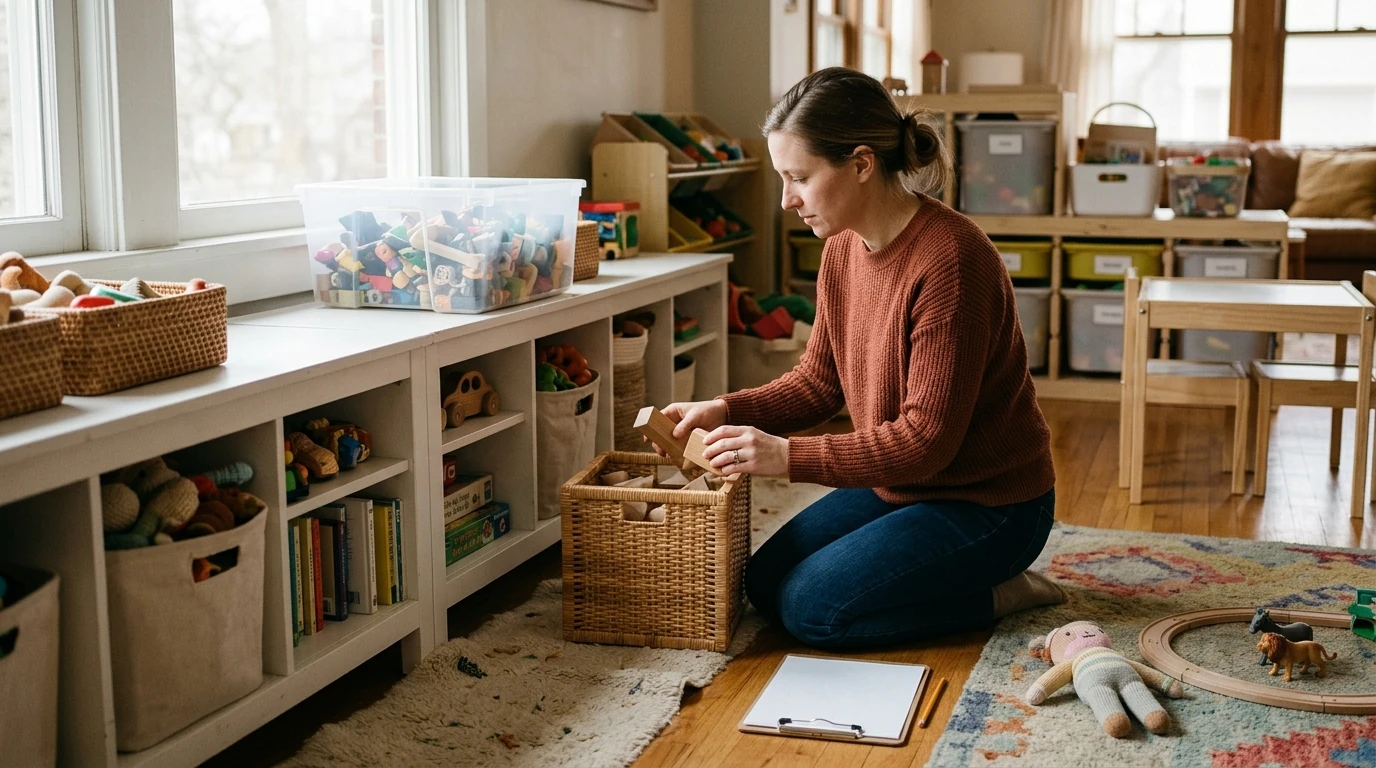
Toys have a way of traveling from one room to another, making it hard to see what your family actually uses. A toy rotation gives you a flexible way to keep some toys available for play while storing others for later. It does not require a perfect playroom or a strict calendar.
Our The Smart Toy Rotation & Storage Checklist is a printable digital guide for parents who want a more organized routine. You can use it alongside the simple steps below, adjusting the process to fit your children and your space.
Start with the toys your family already has
Gather toys from the playroom, bedrooms, living room, and any other spots where they tend to collect. You do not have to tackle the whole house at once: one shelf or basket is a useful starting point.
Sort what you find into broad groups, such as building toys, pretend-play items, books, puzzles, and games. Keep the categories simple enough that you can recognize them again when it is time to tidy up.
As you sort, set aside broken items and check whether each toy is appropriate for your children’s ages and abilities. Pay particular attention to loose pieces and damaged parts. The U.S. Consumer Product Safety Commission’s toy safety tips can help you make safer choices.
Next, choose a manageable selection for the play area. Leave favorite and frequently used toys available rather than putting them away simply because you are starting a rotation. The goal is to make play and cleanup easier, not to interrupt an activity your child loves.
Make a rotation plan that fits your week
Divide the toys you are storing into small collections with different kinds of play. You might pair a construction set with pretend-play pieces and a puzzle, for example. A mix gives you options without requiring you to bring everything out at once.
There is no required schedule. Swap a few items when interest changes, when you notice a shelf has become crowded, or when you have time during your usual household routine. You can replace one basket instead of refreshing the whole play area.
| Toy group | Keep available | Store for later |
|---|---|---|
| Building | A small set of blocks | Another construction set |
| Pretend play | A few play-kitchen pieces | Dress-up accessories |
| Puzzles and games | One or two familiar choices | Other age-appropriate puzzles |
Use the checklist to guide your planning and keep track of your routine. If you prefer, start with just two collections: one in use and one stored away. You can change the groups as you learn what works.
Store toys so swaps are easy
Keep related pieces together in labeled containers, bags, or baskets. A label such as “train set” or “puzzles” makes it easier to find a collection without opening every container. Containers you already own can work well; choose sizes that fit both the toys and the space you have.
Place stored collections where an adult can reach them easily. Keep small parts and toys that are not appropriate for younger children out of their reach, and follow the age guidance on toys. If children share a play area, separate older children’s small-piece sets from toys accessible to younger siblings.
Leave a little room in each container for a quick tidy-up. An overfilled bin can make putting things away frustrating, so split a collection or use a larger container if pieces are difficult to return. A clear shelf or a designated basket for stray pieces can also make the next swap simpler.
Use the printable checklist to keep the routine manageable
Our team offers The Smart Toy Rotation & Storage Checklist as a printable digital download for parents planning an organized playroom. It is listed at $28.99. Visit the product page to explore the guide.
Refer to the checklist during your initial setup, then bring it out again when you are ready to refresh the play area. A repeatable routine can be as simple as looking over what is available, choosing a few items to store, and bringing out something different.
If you also run a small business, our AI for Small Business Toolkit is a separate digital download for your business planning—not a toy storage tool.
Keep the system flexible
The right number of toys depends on your children’s interests, your available space, and how much your household wants to manage. Some families may enjoy a mostly open shelf; others may prefer several baskets of choices. Adjust the selection if play feels limited or cleanup becomes difficult.
Invite children to help with age-appropriate sorting and tidying. They might match puzzle pieces to a box, choose a book for the shelf, or help decide which toys to bring out next. Giving them a small role can make the routine feel familiar without turning it into a major project.
Revisit your setup as children grow, interests change, or your storage needs shift. For more guidance on choosing play materials, see the American Academy of Pediatrics’ discussion of selecting appropriate toys.
FAQ
How often should I rotate toys?
There is no fixed interval. Swap toys when your children’s interests change or when it is convenient for your family.
Do I need special storage containers for toy rotation?
No special containers are required. Use suitable containers you already have, and group and label them to make swaps easier.
What is the Smart Toy Rotation & Storage Checklist?
It is a printable digital download intended to help parents plan toy rotation and storage.
Recommended for you


Is a Motion Sensor Trash Can Worth It? Pros and Cons
Nov 13, 2026
How to Handle Flight Delays and Cancellations
Nov 13, 2026













Leave a comment