-
Shop
- Advanced Technologies
- AI Skills
- Bathroom
- Best-Sellers
- Car Accessories
- Confidence
- Dating & Social Skills
- Digital Resources
- AI & Technology
- Beauty
- Budgeting & Saving
- Car Buying & Ownership
- Cozy Feast Collection
- Electronics & Technology
- Entrepreneurship & Business Growth
- Financial Education
- Financial Independence
- Financial Mindset & Psychology
- Goal Setting
- Home Styling & Organization
- Kitchen & Recipes
- Leadership
- Mindfulness
- Mindset
- Online Business
- Parenting & Child Development
- Personal Style & Fashion
- Pet Lifestyle & Wellness
- Positive Thinking
- Sleep Improvement
- Smart Life with AI
- Stress Management & Relaxation
- Travel Planning
- Wellness
- Yoga & Fitness
- Yoga & Mind-Body Practices
- Education & Learning
- Family & Parenting
- Fashion
- Accessories
- Alexander McQueen
- Bags
- Bags & Wallets
- Balenciaga
- Belts
- Blazers
- Bottega Veneta
- Bottoms
- Brunello Cucinelli
- Burberry
- Chanel
- Chloé
- Dior
- Dolce & Gabbana
- Dresses
- Etro
- Fendi
- Gucci
- Hats & Hair Accessories
- Hoodies & Sweatshirts
- Jacquemus
- Jewelry
- Jil Sander
- Kiton
- Luggage
- Miu Miu
- Off-White
- Outerwear
- Prada
- Rick Owens
- Saint Laurent
- Shoes
- Socks & Tights
- Sweaters & Cardigans
- The Row
- Tom Ford
- Tops & Shirts
- Valentino
- Valentino Garavani
- Versace
- Vivienne Westwood
- Watches
- Fashion Accessories
- Furniture
- Gadgets
- Health & Beauty
- Health & Wellness
- Home & Garden
- Home Decor
- Home Electronics
- Home Supplies
- Kids & Babies
- Kitchen
- Kitchen Best-Sellers
- Lighting
- Patio, Lawn & Garden
- Personal Growth
- Pet Care
- Pet Supplies
- Pets
- Sport & Outdoors
- Super Deals
- Travel
- Travel & Adventure
- Wealth
- Popular
- Best deals
Daily Task Mastery with ChatGPT: Top 3, Blocks, Review

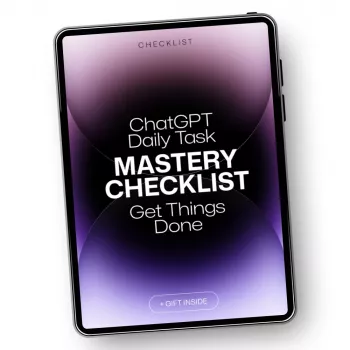
ChatGPT Daily Task Mastery Checklist: a simple way to finish what you start
Busy days don’t usually fail because you didn’t try—they fail because priorities blur, tasks sprawl, and the next step isn’t obvious. Our team built the ChatGPT Daily Task Mastery Checklist: Get Things Done to be a lightweight, repeatable planner that turns ChatGPT into a daily execution partner. You’ll clarify what matters, translate it into doable actions, and keep momentum through the day with short, practical check-ins.
This isn’t another complicated productivity “system.” It’s a daily loop you can run even when your schedule is messy: plan, do, adjust, and close the day cleanly—so tomorrow starts with direction, not clutter.
What this checklist helps solve (without adding another complicated system)
- Stops the “open tabs” effect: you capture everything in one place before deciding what to do.
- Makes goals actionable: vague outcomes become concrete next actions ChatGPT can help draft, outline, or break down.
- Creates a daily rhythm: plan → execute → review, so unfinished tasks don’t silently pile up.
- Reduces decision fatigue: you use the same method to pick priorities instead of renegotiating your day every hour.
- Improves follow-through: each task gets a success condition and a time estimate, so it’s harder to “almost finish” forever.
How to set it up in 10 minutes
- Choose one home base: print it, use it in a notes app, or keep it beside your calendar—consistency beats perfection.
- Pick a planning window: 8–12 minutes at the start of your workday is enough for most people.
- Choose 1–3 outcomes: not a long to-do list—just the results that would make today feel successful.
- Define constraints up front: fixed meetings, deadlines, personal commitments, and your energy level.
- Open ChatGPT with one job: convert your outcomes into a short action plan with realistic timing.
If you want to scale beyond personal planning later (team workflows, SOPs, customer messaging), our AI for Small Business Toolkit – 5-in-1 Digital Download Bundle pairs well with the checklist: the toolkit handles the bigger reusable templates while the checklist keeps your day moving.
The daily workflow: plan, run, close the loop
1) Capture → 2) Triage → 3) Commit
Start by dumping every task and worry onto the list—then stop. Next, mark what’s urgent, what’s important, and what can wait (or be deleted). Finally, commit to your “Top 3” plus one optional bonus item only if time remains.
Execute in blocks (with tiny check-ins)
Work in focused sprints, then use short ChatGPT check-ins to remove friction and identify the smallest next step. The point is to stay in motion, not to generate perfect plans.
Close the day (so tomorrow starts lighter)
End with a quick review: note wins, roll over only what still matters, and write one sentence about what you’ll do differently tomorrow. This is where the checklist pays compounding returns—because you stop re-learning the same lessons every morning.
| Moment | Checklist move | ChatGPT prompt to use | What to save |
|---|---|---|---|
| Start of day (8–12 min) | Turn goals into a plan | Here are my tasks and meetings today: [paste]. Help me choose the top 3 outcomes and write a realistic schedule with time blocks. Ask me 3 questions if needed. | Top 3 outcomes + time blocks |
| Before each work block (1 min) | Clarify the next step | For this task: [task]. Define the smallest next action that moves it forward in 15–30 minutes. Provide a checklist of micro-steps. | Micro-checklist |
| When stuck (2–3 min) | Remove friction | I’m blocked because: [reason]. Give me 5 ways to unblock, starting with the easiest. Include one “good enough” option. | Unblock options |
| Midday reset (3–5 min) | Re-prioritize | Here’s what’s done and what’s not: [paste]. Re-rank the remaining tasks based on impact and deadlines, and suggest what to defer. | Updated priorities |
| End of day (5 min) | Review + rollover | Summarize what I completed today: [paste]. Create a rollover list for tomorrow with the top 3, and write a 2-sentence improvement plan. | Tomorrow’s Top 3 + notes |
ChatGPT request patterns that produce better daily output
For usage guidance and account basics, OpenAI’s official documentation can be a helpful reference: OpenAI Help Center. If you’re applying AI in a business context and care about risk and governance, NIST’s framework is a solid grounding point: NIST AI Risk Management Framework.
Using the checklist for different kinds of workdays
If your daily work includes money movement—quotes, invoices, processing fees, or checkout decisions—our team also stocks Choosing the Right Payment Solution for Your Business: Stripe vs Square Which Is Better as a practical reference alongside your day-to-day execution planning.
Common pitfalls (and quick fixes that keep momentum)
FAQ
How many ChatGPT prompts are there daily?
There’s no fixed number; most people do best with a small set they reuse: start-of-day plan, next-step clarification, unblock, midday reprioritize, and end-of-day review. Consistency matters more than adding more.
Can ChatGPT do tasks for you?
ChatGPT can draft, outline, summarize, structure plans, generate checklists, and support decisions. You still handle real-world execution like sending messages, making calls, and giving final approval.
What are some good ChatGPT prompts for creating a daily schedule?
Use prompts that include meetings, deadlines, energy level, and the format you want (time blocks, Top 3, and buffers). Ask it to propose a realistic schedule and to ask clarifying questions before it locks in the plan.
Recommended for you


Totally Free Meditation Apps: What’s Actually Free?
Oct 17, 2026













Leave a comment