-
Shop
- Advanced Technologies
- AI Skills
- Bathroom
- Best-Sellers
- Car Accessories
- Confidence
- Dating & Social Skills
- Digital Resources
- AI & Technology
- Beauty
- Budgeting & Saving
- Car Buying & Ownership
- Cozy Feast Collection
- Electronics & Technology
- Entrepreneurship & Business Growth
- Financial Education
- Financial Independence
- Financial Mindset & Psychology
- Goal Setting
- Home Styling & Organization
- Kitchen & Recipes
- Leadership
- Mindfulness
- Mindset
- Online Business
- Parenting & Child Development
- Personal Style & Fashion
- Pet Lifestyle & Wellness
- Positive Thinking
- Sleep Improvement
- Smart Life with AI
- Stress Management & Relaxation
- Travel Planning
- Wellness
- Yoga & Fitness
- Yoga & Mind-Body Practices
- Education & Learning
- Family & Parenting
- Fashion
- Accessories
- Alexander McQueen
- Bags
- Bags & Wallets
- Balenciaga
- Belts
- Blazers
- Bottega Veneta
- Bottoms
- Brunello Cucinelli
- Burberry
- Chanel
- Chloé
- Dior
- Dolce & Gabbana
- Dresses
- Etro
- Fendi
- Gucci
- Hats & Hair Accessories
- Hoodies & Sweatshirts
- Jacquemus
- Jewelry
- Jil Sander
- Kiton
- Luggage
- Miu Miu
- Off-White
- Outerwear
- Prada
- Rick Owens
- Saint Laurent
- Shoes
- Socks & Tights
- Sweaters & Cardigans
- The Row
- Tom Ford
- Tops & Shirts
- Valentino
- Valentino Garavani
- Versace
- Vivienne Westwood
- Watches
- Fashion Accessories
- Furniture
- Gadgets
- Health & Beauty
- Health & Wellness
- Home & Garden
- Home Decor
- Home Electronics
- Home Supplies
- Kids & Babies
- Kitchen
- Kitchen Best-Sellers
- Lighting
- Patio, Lawn & Garden
- Personal Growth
- Pet Care
- Pet Supplies
- Pets
- Sport & Outdoors
- Super Deals
- Travel
- Travel & Adventure
- Wealth
- Popular
- Best deals
Smooth First Day of School: 7-Day Calm Parent Plan
Calm, Confident, and Ready for the Big School Day: A Parent Plan for a Smooth First Day
A smooth first day of school is less about perfection and more about preparation, predictable routines, and helping kids practice brave steps ahead of time. When mornings feel familiar and goodbyes feel steady, kids have fewer “unknowns” to worry about—and parents have fewer last-minute fires to put out. Use the plan below to reduce morning friction, ease separation worries, and set a calm, confident tone that can last well beyond day one.
Start With the Feelings: What Calm and Confident Looks Like for Kids
Kids can feel excited and worried at the same time. That mix often shows up as “but what if…?” questions right when you’re trying to keep things upbeat. Treat those questions as information, not misbehavior: your child is scanning for safety and predictability.
- Name what’s normal: excitement, worry, and “what if” thoughts can travel together.
- Watch for stress signals (stomachaches, irritability, clinginess, sleep changes) and see them as cues to add support—not pressure.
- Pick a family mantra that’s easy to remember: “steady and ready,” “safe and capable,” or “calm and brave.”
- Aim for “confident enough,” not fearless. Confidence often grows after kids do the hard thing.
If you’d like a quick set of evidence-based back-to-school reminders, the American Academy of Pediatrics has a helpful overview of routines and readiness: American Academy of Pediatrics — Back-to-School Tips.
A 7-Day Countdown Routine That Builds Confidence
Confidence is easier to build in small reps than in one big leap. Think “practice, not pressure.”
- Day 7–5: Rehearse the morning rhythm (wake time, breakfast, getting dressed) without rushing; keep it light and brief.
- Day 4–3: Practice the route to school or the bus stop; point out landmarks and where caregivers will be at pickup.
- Day 2: Do a “mini first day” at home—pack the bag, choose clothes, set alarms, and do a short goodbye practice.
- Day 1 (eve): Choose a calm activity after dinner; keep screens low; set out everything before bedtime.
- Use small choices to increase ownership: which snack, which socks, which pencil case—within boundaries.
First-Day Prep Timeline (Copy/Paste Checklist)
| When | Do This | Why It Helps |
|---|---|---|
| 1 week before | Confirm school start time, drop-off plan, after-school plan, and required items | Removes last-minute surprises that spike anxiety |
| 3–5 days before | Shift bedtime/wake time by 10–15 minutes per day if needed | Supports energy, mood, and attention |
| 2–3 days before | Short school visit or drive-by; identify entrance and classroom area if possible | Makes the setting feel familiar |
| Night before | Lay out clothes, pack bag, prep water bottle/lunch, set alarms | Reduces morning decision fatigue |
| Morning of | Leave 10–15 minutes earlier than necessary; build in a buffer | Prevents rushed emotions from taking over |
Pack With Purpose: What to Prepare (and What to Skip)
Packing is most helpful when it reduces friction for your child at school. The goal: “easy to open, easy to find, easy to keep.”
- Essentials: labeled backpack, lunch/snack items (if needed), water bottle, any required forms/meds, and weather gear.
- Comfort without clutter: one small transitional item if allowed (a note in the pocket, a keychain, a smooth “worry stone”).
- Keep it simple: avoid brand-new, complicated containers or gadgets that can frustrate kids at lunch.
- Label everything: jackets, hoodies, lunch boxes, and water bottles tend to “walk away.”
Goodbye Scripts That Reduce Separation Anxiety
A confident goodbye is brief, warm, and predictable. It signals to your child’s nervous system: “This is safe, and adults are in charge.”
- Keep goodbyes short and consistent: a hug, a phrase, and a clear handoff to the teacher.
- Use a clear timeline: “After school, I’ll be right here at pickup.” Avoid vague “soon.”
- Avoid repeated returns after saying goodbye; it can accidentally train extra reassurance loops.
- Try a simple script: “You’re safe. Your teacher will help you. I’ll see you after school. Love you—bye.”
- If tears happen: validate (“This is hard”) and still follow through with the plan.
When Anxiety Shows Up: Tools to Help Kids Settle
Anxiety often looks physical first. When you help the body calm down, the brain can catch up.
For more guidance on kids and stress, the CDC offers practical context on symptoms and support: CDC — Helping Children Cope with Stress.
Make Mornings Easier: Small Systems That Prevent Big Meltdowns
Support That Extends Beyond Day One
A Practical Parent Guide for a Smooth First Day
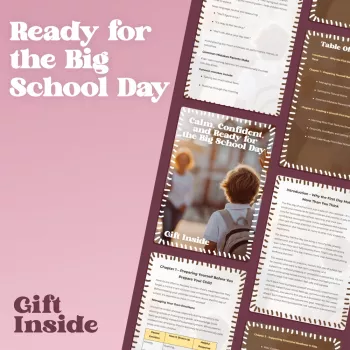
Calm, Confident, and Ready for the Big School Day: The Ultimate Parent Guide for a Smooth First Day of School is a ready-to-use option designed around practical routines, packing lists, and goodbye strategies.
For parents who are also managing a business schedule around the new school routine, a separate planning resource can help streamline your workload: AI for Small Business Toolkit – 5-in-1 Digital Download Bundle.
FAQ
What is another way to say calm and confident?
Try “steady and ready” for mornings, “relaxed and capable” for social situations, or “grounded and assured” when your child needs reassurance that they can handle what’s next.
How to overcome anxiety and be calm and confident?
Normalize the nerves, practice the routine ahead of time, teach one breathing or grounding tool, and use a short, predictable goodbye. If the anxiety is intense or doesn’t improve after the first couple of weeks, ask your pediatrician or school counselor for support.
How to be a calm and confident person?
It’s a skill built through steady sleep, simple coping tools, kind self-talk, and doing small hard things repeatedly. For kids, it grows fastest with predictable routines and supportive adults who model calm follow-through.














Leave a comment