-
Shop
- Advanced Technologies
- AI Skills
- Bathroom
- Best-Sellers
- Car Accessories
- Confidence
- Dating & Social Skills
- Digital Resources
- AI & Technology
- Beauty
- Budgeting & Saving
- Car Buying & Ownership
- Cozy Feast Collection
- Electronics & Technology
- Entrepreneurship & Business Growth
- Financial Education
- Financial Independence
- Financial Mindset & Psychology
- Goal Setting
- Home Styling & Organization
- Kitchen & Recipes
- Leadership
- Mindfulness
- Mindset
- Online Business
- Parenting & Child Development
- Personal Style & Fashion
- Pet Lifestyle & Wellness
- Positive Thinking
- Sleep Improvement
- Smart Life with AI
- Stress Management & Relaxation
- Travel Planning
- Wellness
- Yoga & Fitness
- Yoga & Mind-Body Practices
- Education & Learning
- Family & Parenting
- Fashion
- Accessories
- Alexander McQueen
- Bags
- Bags & Wallets
- Balenciaga
- Belts
- Blazers
- Bottega Veneta
- Bottoms
- Brunello Cucinelli
- Burberry
- Chanel
- Chloé
- Dior
- Dolce & Gabbana
- Dresses
- Etro
- Fendi
- Gucci
- Hats & Hair Accessories
- Hoodies & Sweatshirts
- Jacquemus
- Jewelry
- Jil Sander
- Kiton
- Luggage
- Miu Miu
- Off-White
- Outerwear
- Prada
- Rick Owens
- Saint Laurent
- Shoes
- Socks & Tights
- Sweaters & Cardigans
- The Row
- Tom Ford
- Tops & Shirts
- Valentino
- Valentino Garavani
- Versace
- Vivienne Westwood
- Watches
- Fashion Accessories
- Furniture
- Gadgets
- Health & Beauty
- Health & Wellness
- Home & Garden
- Home Decor
- Home Electronics
- Home Supplies
- Kids & Babies
- Kitchen
- Kitchen Best-Sellers
- Lighting
- Patio, Lawn & Garden
- Personal Growth
- Pet Care
- Pet Supplies
- Pets
- Sport & Outdoors
- Super Deals
- Travel
- Travel & Adventure
- Wealth
- Popular
- Best deals
Self-Doubt Release Toolkit: Reset Fear, Build Confidence
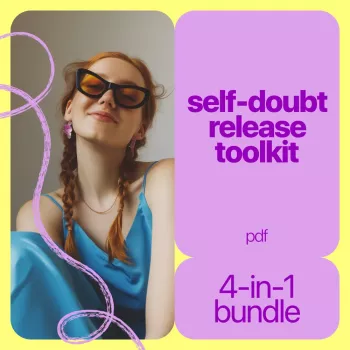
Self-Doubt Release Toolkit: a clear, practical path to more confidence
Self-doubt can sound like “I’m not ready,” “I’ll mess it up,” or “Someone else could do this better.” It often shows up right before growth: a new role, a brave conversation, a creative launch, a boundary, a pivot. Our Self-Doubt Release Toolkit is built for that exact moment—when you do want to move forward, but your confidence feels unsteady. This 4-in-1 digital bundle helps you turn spiraling thoughts into structured steps, so action feels safer, clearer, and more consistent.
We designed it around practical, repeatable tools that reflect principles commonly used in evidence-based approaches like cognitive behavioral therapy (CBT)—separating facts from predictions, challenging unhelpful beliefs, and pairing mindset shifts with behavior change. If you’d like background reading, the American Psychological Association’s overview of CBT and the NHS guide to CBT offer a helpful foundation.
Who this toolkit is for (and when it helps most)
This bundle supports you when you’re capable, motivated, and still getting derailed by doubt. Our team built it for real-life moments like:
- When overthinking delays decisions: choosing a direction, sending the message, submitting the work, making the call.
- When perfectionism sets the rules: waiting until it’s “good enough” before sharing, applying, pitching, or posting.
- When self-talk turns harsh under pressure: interpreting normal mistakes as proof you’re not capable.
- When confidence feels inconsistent: feeling strong one day and second-guessing everything the next.
- When progress stalls at the starting line: planning endlessly instead of taking the first small step.
What’s inside the 4-in-1 digital bundle
You’re getting four coordinated tools that work together: identify the self-doubt pattern, interrupt it, replace it with a usable perspective, and follow through with an action plan. They’re designed for quick prompts on busy days and deeper exercises when you have more time—and the same framework can be reused across work, relationships, personal goals, creativity, health, and social confidence.
How the toolkit components work together
| Toolkit part | What it helps with | When to use it | Outcome to look for |
|---|---|---|---|
| Clarity prompts | Separating facts from fear-driven stories | When thoughts feel loud or confusing | A calmer, more realistic view of the situation |
| Mindset reset exercises | Challenging unhelpful beliefs and assumptions | When confidence drops after a setback | A more balanced inner narrative |
| Confidence-building practice | Strengthening self-trust through small wins | When motivation exists but follow-through feels hard | Momentum and evidence of capability |
| Action plan templates | Turning insight into steps and deadlines | When you’re ready to move forward but unsure how | A next step that feels doable and clear |
A simple way to use it: the 15–30 minute confidence reset
If you want a straightforward starting routine, use this reset once and then repeat it as needed. The goal isn’t “perfect mindset,” it’s forward motion with less friction.
- Name the moment: write the situation in one sentence (example: “I want to apply, but I’m afraid I’m not qualified”).
- Spot the doubt script: identify the repeating pattern (catastrophizing, mind-reading, all-or-nothing thinking, discounting wins).
- Reality-check the story: list observable facts, then list fear-based predictions separately.
- Choose one supportive reframe: not forced positivity—just a realistic, usable statement (example: “I can apply and still be learning”).
- Commit to one next step: one action under 20 minutes (draft the email, outline the application, practice for 10 minutes).
- Close the loop: record what happened after taking action so you build evidence that self-doubt doesn’t get the final say.
Common self-doubt patterns the toolkit helps interrupt
To strengthen the “kinder, steadier inner voice” side of this work, self-compassion practices can also be supportive. UC Berkeley’s Greater Good Science Center has a solid overview of self-compassion and why it matters during setbacks.
Making confidence sustainable (not just a one-time boost)
When to pair this toolkit with a business-focused system
If self-doubt is blocking execution in a business or side project, it helps to combine internal clarity with external structure. Use the toolkit to quiet the mental noise, then move into workflows that reduce decision fatigue and make follow-through more automatic. If that’s your current season, our team also offers the AI for Small Business Toolkit – 5-in-1 Digital Download Bundle to support planning, prompts, and repeatable execution.
Get the toolkit and start with one small win
- Self-Doubt Release Toolkit: Overcome Self-Doubt & Boost Confidence – 4-in-1 Digital Bundle
- AI for Small Business Toolkit – 5-in-1 Digital Download Bundle
- Choosing the Right Payment Solution for Your Business: Stripe vs Square Which Is Better – Complete eBook Guide for Small Business Owners
FAQ
How quickly can this toolkit help reduce self-doubt?
Some people feel calmer after one reset session, especially once the thoughts are organized into facts, fears, and a next step. More lasting confidence typically builds through repeated use: small actions, quick reflection, and evidence tracking over time.
Is this bundle better for mindset work or taking action?
It’s designed to do both: the prompts and exercises reduce spirals and soften harsh self-talk, while the action plan templates convert clarity into a doable next step. The combination is what turns “I feel better” into “I followed through.”
Can it help with impostor feelings at work or in business?
Yes—especially for patterns like discounting achievements, fearing you’ll be “found out,” or treating normal learning moments as failure. The toolkit guides you to collect realistic evidence, use balanced reframes, and commit to small actions that rebuild self-trust.
Recommended for you

Fix Poor Room Lighting: Bulbs, Layers & Placement
Oct 10, 2026
Four Pillars of Confidence: Build Self-Belief Fast
Oct 10, 2026













Leave a comment