-
Shop
- Advanced Technologies
- AI Skills
- Bathroom
- Best-Sellers
- Car Accessories
- Confidence
- Dating & Social Skills
- Digital Resources
- AI & Technology
- Beauty
- Budgeting & Saving
- Car Buying & Ownership
- Cozy Feast Collection
- Electronics & Technology
- Entrepreneurship & Business Growth
- Financial Education
- Financial Independence
- Financial Mindset & Psychology
- Goal Setting
- Home Styling & Organization
- Kitchen & Recipes
- Leadership
- Mindfulness
- Mindset
- Online Business
- Parenting & Child Development
- Personal Style & Fashion
- Pet Lifestyle & Wellness
- Positive Thinking
- Sleep Improvement
- Smart Life with AI
- Stress Management & Relaxation
- Travel Planning
- Wellness
- Yoga & Fitness
- Yoga & Mind-Body Practices
- Education & Learning
- Family & Parenting
- Fashion
- Accessories
- Alexander McQueen
- Bags
- Bags & Wallets
- Balenciaga
- Belts
- Blazers
- Bottega Veneta
- Bottoms
- Brunello Cucinelli
- Burberry
- Chanel
- Chloé
- Dior
- Dolce & Gabbana
- Dresses
- Etro
- Fendi
- Gucci
- Hats & Hair Accessories
- Hoodies & Sweatshirts
- Jacquemus
- Jewelry
- Jil Sander
- Kiton
- Luggage
- Miu Miu
- Off-White
- Outerwear
- Prada
- Rick Owens
- Saint Laurent
- Shoes
- Socks & Tights
- Sweaters & Cardigans
- The Row
- Tom Ford
- Tops & Shirts
- Valentino
- Valentino Garavani
- Versace
- Vivienne Westwood
- Watches
- Fashion Accessories
- Furniture
- Gadgets
- Health & Beauty
- Health & Wellness
- Home & Garden
- Home Decor
- Home Electronics
- Home Supplies
- Kids & Babies
- Kitchen
- Kitchen Best-Sellers
- Lighting
- Patio, Lawn & Garden
- Personal Growth
- Pet Care
- Pet Supplies
- Pets
- Sport & Outdoors
- Super Deals
- Travel
- Travel & Adventure
- Wealth
- Popular
- Best deals
Fuel Your Fire: How to Start Difficult Tasks

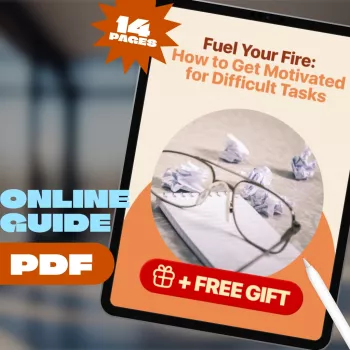
Some tasks seem to get heavier the longer they wait. You may know a report needs writing or a room needs attention, yet finding a place to begin can feel surprisingly difficult. You don’t have to solve the whole problem before you start. A small, specific action can make the task easier to approach. Our digital self-help guide, Fuel Your Fire, is a motivation resource for difficult tasks and procrastination. Pairing reflection with a practical first move can help you find a way forward without waiting for the perfect mood. For more guidance, see Success_Habits_For_Dummies.pdf.
Why Difficult Tasks Can Feel Hard to Start
A difficult task often contains more unknowns than its name suggests. “Write a report” might mean gathering information, deciding what matters, organizing your thoughts, and worrying about whether the finished work will be good enough. When those decisions arrive all at once, even opening a document can feel daunting. For further reading, see 100 Ways to Motivate Yourself Change Your Life Forever. ….
Overwhelm can also make the first step hard to see. You may picture the entire project rather than the next action within reach. Fear of an imperfect result can add pressure, making postponement feel more comfortable than beginning.
Starting small doesn’t make every obstacle disappear, but action can create useful information. Once you begin, you may discover what you already know and what needs attention next. Motivation can grow after you take that first step, rather than arriving before it. The Centre for Clinical Interventions’ procrastination resources offer further guidance on understanding and addressing procrastination.
Make the First Move Smaller
Begin by naming the task plainly. Instead of “fix everything,” try “organize the desk” or “prepare for Friday’s exam.” Then choose one action you can see yourself completing without first resolving every uncertainty.
Give that action a short work period. A timer can make the commitment feel more manageable: you’re agreeing to work for a few minutes, not promising to finish the whole project. When the time ends, you can stop, continue, or decide what needs to happen next.
These examples can help you turn a broad task into a starting point:
| Task | Possible first step | Short work period |
|---|---|---|
| Write a report | Open a document and list three points | 10 minutes |
| Organize a room | Clear one surface | 10 minutes |
| Prepare for an exam | Choose one topic and review a page | 15 minutes |
Adjust the time to suit your day. If ten minutes still feels too large, choose five. The goal is to make a useful start, not to prove how much you can finish at once.
Use Fuel Your Fire as a Motivation Resource
Our Fuel Your Fire motivation guide is a PDF digital download eBook focused on getting motivated for difficult tasks and overcoming procrastination. It is listed at $7.99.
To use it alongside your own plans, set aside a little time to read and reflect without expecting an instant transformation. Consider the task you’ve been avoiding as you read, then choose one idea that feels useful and apply it to that task. You might make a note of what you want to try and when you’ll try it.
Our team sees resources like this as a way to support your efforts, not as a promise of a particular result. If your task involves exploring technology for your business, our AI for Small Business Toolkit is a separate digital bundle you can consider for that subject.
Build Momentum Without Waiting for a Perfect Day
Choose a time that fits the life you actually have. A short session after breakfast or before an appointment may be more realistic than an open-ended plan to work “sometime tomorrow.” Put it on your calendar or connect it to a routine you already follow.
Before you begin, reduce one distraction. You could silence notifications, close an unrelated browser tab, or move your materials to a clearer surface. You don’t need a flawless workspace; removing one barrier can make it easier to focus on the next action.
It also helps to define a useful stopping point. That might mean drafting one paragraph, sorting a single shelf, or identifying the question you need to ask next. A clear endpoint lets you recognize progress even when the larger task remains unfinished.
If you get interrupted, avoid treating the break as a failed attempt. Note where you stopped and choose another small action for your return. Restarting is part of the process, not evidence that your earlier effort didn’t count.
Choose Your Next Step
Pick one task you’ve been avoiding and write down its smallest useful first action. Make it specific enough that you’ll know when you’ve done it: “find the report notes” is easier to begin than “get organized.” Choose a short time to start, and give yourself permission to stop when it ends.
Progress doesn’t have to look dramatic to matter. If you’d like another resource as you work on motivation, explore Fuel Your Fire and consider how its ideas might support the next step you choose.
FAQ
How can I get motivated to start a difficult task?
Choose one small, specific action and plan a short period to work on it. You don’t have to feel fully ready before you begin.
What format is Fuel Your Fire available in?
Fuel Your Fire is listed as a PDF digital download eBook.
Can Fuel Your Fire guarantee that I will stop procrastinating?
No. It is a self-help resource, not a guarantee of a particular outcome or a substitute for professional support.
Recommended for you


Adidas Men’s Printed Hooded Sweatshirt: Style Guide
Nov 21, 2026













Leave a comment