-
Shop
- Advanced Technologies
- AI Skills
- Bathroom
- Best-Sellers
- Car Accessories
- Confidence
- Dating & Social Skills
- Digital Resources
- AI & Technology
- Beauty
- Budgeting & Saving
- Car Buying & Ownership
- Cozy Feast Collection
- Electronics & Technology
- Entrepreneurship & Business Growth
- Financial Education
- Financial Independence
- Financial Mindset & Psychology
- Goal Setting
- Home Styling & Organization
- Kitchen & Recipes
- Leadership
- Mindfulness
- Mindset
- Online Business
- Parenting & Child Development
- Personal Style & Fashion
- Pet Lifestyle & Wellness
- Positive Thinking
- Sleep Improvement
- Smart Life with AI
- Stress Management & Relaxation
- Travel Planning
- Wellness
- Yoga & Fitness
- Yoga & Mind-Body Practices
- Education & Learning
- Family & Parenting
- Fashion
- Accessories
- Alexander McQueen
- Bags
- Bags & Wallets
- Balenciaga
- Belts
- Blazers
- Bottega Veneta
- Bottoms
- Brunello Cucinelli
- Burberry
- Chanel
- Chloé
- Dior
- Dolce & Gabbana
- Dresses
- Etro
- Fendi
- Gucci
- Hats & Hair Accessories
- Hoodies & Sweatshirts
- Jacquemus
- Jewelry
- Jil Sander
- Kiton
- Luggage
- Miu Miu
- Off-White
- Outerwear
- Prada
- Rick Owens
- Saint Laurent
- Shoes
- Socks & Tights
- Sweaters & Cardigans
- The Row
- Tom Ford
- Tops & Shirts
- Valentino
- Valentino Garavani
- Versace
- Vivienne Westwood
- Watches
- Fashion Accessories
- Furniture
- Gadgets
- Health & Beauty
- Health & Wellness
- Home & Garden
- Home Decor
- Home Electronics
- Home Supplies
- Kids & Babies
- Kitchen
- Kitchen Best-Sellers
- Lighting
- Patio, Lawn & Garden
- Personal Growth
- Pet Care
- Pet Supplies
- Pets
- Sport & Outdoors
- Super Deals
- Travel
- Travel & Adventure
- Wealth
- Popular
- Best deals
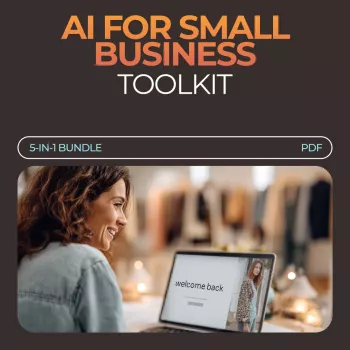
AI for Business Toolkit: 5-in-1 Digital Download Guide

AI can give you a new way to approach recurring work, from drafting a customer response to organizing meeting notes. The key is to choose a task where a first draft or fresh perspective would be useful, then keep a person responsible for the final decision.
Our AI for Small Business Toolkit is a 5-in-1 digital download bundle for business owners exploring how AI might fit into their work. Whether you are just getting started or reconsidering an existing process, begin with a practical need rather than adopting technology for its own sake.
Where AI Can Fit into a Small Business
Small businesses often juggle marketing, customer service, administration, and planning with limited time. AI services may help you brainstorm a promotion, draft a routine email, summarize notes, or create a list of questions for an upcoming decision. These uses can provide a starting point, but they do not replace your knowledge of your customers or your business.
Choose one recurring task that has a clear beginning and end. For example, you might draft responses to common, low-stakes inquiries. Compare each draft with the answer you would normally send, then edit it for accuracy, tone, and relevance. Review every AI-generated result before using it, even when the task seems routine.
A useful first task should also be easy to check. If verifying an output takes more effort than completing the work yourself, try a different task or narrow the request. Keep your existing process available while you decide whether AI is genuinely useful.
Explore the 5-in-1 Digital Download Bundle
Our AI for Small Business Toolkit – 5-in-1 Digital Download Bundle is designed for small business owners exploring AI. It is a digital download bundle, rather than a promise of five named standalone AI services.
The bundle is listed at $430.99 USD and is in stock. Price and availability can change, so visit the product page for current details before deciding whether it fits your priorities.
Consider the purchase alongside the task you want to improve, the time you can devote to learning, and any separate services you may need. A clear starting goal can help you evaluate whether a resource is relevant to your business.
Match AI Opportunities to Business Needs
The following examples are possible AI use cases, not claims about specific bundle contents. Use them to identify one starting task and the human check needed before you act on the result.
| Business task | Possible AI use | Human check |
|---|---|---|
| Marketing | Brainstorm campaign ideas | Check claims and brand fit |
| Customer communication | Draft a response | Confirm accuracy and tone |
| Administration | Summarize notes | Verify important details |
| Planning | Generate questions to consider | Assess relevance and feasibility |
For marketing, you might ask for several campaign angles and select only those that reflect what you actually offer. For administration, compare a summary with the original notes to catch missing dates, commitments, or action items. In both cases, the output is a draft for your review, not an independent source of truth.
Be especially careful with public-facing claims. The Federal Trade Commission’s guidance on AI claims is a reminder to substantiate what you say about a product or service.
Build a Responsible AI Workflow
Start with a low-risk task and define the result you want. You could ask for a concise first draft of a general customer update, for example, then compare it with an update your team has already approved. Look for differences in accuracy, readability, and the time needed to make it usable.
Set a review step before anything reaches a customer or informs a business decision. Assign someone to check facts, remove unsupported statements, and confirm that the result follows your policies. For consequential matters, use qualified human judgment rather than relying on an AI-generated answer alone.
Avoid entering sensitive customer or business information unless the chosen service’s privacy practices permit it. Review how the service handles submitted information, and use generic or non-sensitive examples when possible. If you cannot confirm that a service is appropriate for the information, leave it out.
For a broader approach to identifying and managing risks, our team recommends consulting the NIST AI Risk Management Framework. It can help you consider oversight as you decide where AI belongs in your workflow.
Take the Next Step
Start by writing down one task, the result you want, and who will review it. Then explore our toolkit product page and decide whether the bundle fits your business priorities and budget. You can expand your use of AI gradually as you learn what works and what still needs a human touch.
If you are also evaluating payment solutions, our separate Stripe vs Square guide for small business owners offers a resource for that decision. Payment selection and AI adoption are different considerations, so assess each against your own requirements.
FAQ
What are the top 5 AI tools for business?
The best AI tools depend on your task, budget, privacy requirements, and existing workflow. Standalone AI services are different from our digital download bundle, which should not be assumed to contain five named AI tools.
Is AI Toolkit free?
Our AI for Small Business Toolkit bundle is not free; it is listed at $430.99 USD. Prices and availability may change, so check the product page for current details.
Recommended for you

Little to No Color: The 4-Letter Word and Style Tips
Nov 10, 2026
5 Best AI Tools for Business: Compare Your Options
Nov 10, 2026













Leave a comment