-
Shop
- Advanced Technologies
- AI Skills
- Bathroom
- Best-Sellers
- Car Accessories
- Confidence
- Dating & Social Skills
- Digital Resources
- AI & Technology
- Beauty
- Budgeting & Saving
- Car Buying & Ownership
- Cozy Feast Collection
- Electronics & Technology
- Entrepreneurship & Business Growth
- Financial Education
- Financial Independence
- Financial Mindset & Psychology
- Goal Setting
- Home Styling & Organization
- Kitchen & Recipes
- Leadership
- Mindfulness
- Mindset
- Online Business
- Parenting & Child Development
- Personal Style & Fashion
- Pet Lifestyle & Wellness
- Positive Thinking
- Sleep Improvement
- Smart Life with AI
- Stress Management & Relaxation
- Travel Planning
- Wellness
- Yoga & Fitness
- Yoga & Mind-Body Practices
- Education & Learning
- Family & Parenting
- Fashion
- Accessories
- Alexander McQueen
- Bags
- Bags & Wallets
- Balenciaga
- Belts
- Blazers
- Bottega Veneta
- Bottoms
- Brunello Cucinelli
- Burberry
- Chanel
- Chloé
- Dior
- Dolce & Gabbana
- Dresses
- Etro
- Fendi
- Gucci
- Hats & Hair Accessories
- Hoodies & Sweatshirts
- Jacquemus
- Jewelry
- Jil Sander
- Kiton
- Luggage
- Miu Miu
- Off-White
- Outerwear
- Prada
- Rick Owens
- Saint Laurent
- Shoes
- Socks & Tights
- Sweaters & Cardigans
- The Row
- Tom Ford
- Tops & Shirts
- Valentino
- Valentino Garavani
- Versace
- Vivienne Westwood
- Watches
- Fashion Accessories
- Furniture
- Gadgets
- Health & Beauty
- Health & Wellness
- Home & Garden
- Home Decor
- Home Electronics
- Home Supplies
- Kids & Babies
- Kitchen
- Kitchen Best-Sellers
- Lighting
- Patio, Lawn & Garden
- Personal Growth
- Pet Care
- Pet Supplies
- Pets
- Sport & Outdoors
- Super Deals
- Travel
- Travel & Adventure
- Wealth
- Popular
- Best deals
Women’s Beginner Weightlifting Plan: Start Strong in 2 Weeks
Lift Strong, Start Confident: A Beginner-Friendly Weightlifting Start Plan for Women (Digital Guide)
Starting weightlifting can feel like learning a new language—equipment, form cues, gym etiquette, and the constant question: “Am I doing this right?” Our team built Lift Strong, Start Confident to remove the guesswork with a clear, beginner-first path: what to do on Day 1, what to track, how to progress, and how to build strength without burnout. If you want a plan that helps you go from uncertain to consistent—one simple session at a time—this is the framework to follow. For more guidance, see How can strength training build healthier bodies as we age?.
Who This Guide Is For (and What It Helps You Avoid)
If you’ve been circling the weight room, saving workouts, and still not sure what to do when you walk in, you’re not alone. This guide is for you if you want structure and a calm, repeatable starting point. For further reading, see NASM Programming & Training Materials | Free Fitness ….
- For beginners who want structure: a step-by-step start instead of random workouts.
- For women who want strength without intimidation: plain-language explanations and confidence-building pacing.
- For anyone who has tried “winging it” and stalled: a progression framework so your workouts keep working.
- Helps you avoid early mistakes: doing too much too soon, skipping warm-ups, copying advanced routines, and changing plans every week.
If you want a simple, usable plan you can follow consistently, our digital guide is designed to be training wheels you actually use during the week—not just something you read once.
Your First Two Weeks: A Simple Start That Builds Momentum
The goal in Weeks 1–2 is not to “max out.” It’s to learn movement patterns, repeat the same lifts enough to feel familiar, and finish sessions feeling capable—not crushed. Pick a schedule you can actually keep, then stick to it for at least two weeks (ideally four) before changing anything.
Beginner Schedule Options (Choose One and Stick With It for 2–4 Weeks)
| Option | Weekly Frequency | Best For | What to Repeat |
|---|---|---|---|
| A: Minimal & Consistent | 2 days/week | Busy schedules, gym nerves, soreness-prone beginners | Same full-body workout both days |
| B: Classic Beginner | 3 days/week | Faster skill-building and routine lovers | Same full-body workout 3x/week |
| C: Hybrid | 2 strength + 1 optional | Those who want flexibility | 2 full-body days + optional technique/cardio day |
Set a baseline by choosing starting weights that let you move with control. If your form gets shaky, your shoulders hike, or you’re holding your breath the entire set, that’s a sign the load is too heavy for learning week.
What to Do in Each Workout (So You Never Walk In Lost)
A beginner session doesn’t need 14 exercises to be effective. You’ll get more from a short, repeatable structure you can run again and again.
- Warm-up (5–8 minutes): light cardio + joint prep + 1–2 ramp-up sets for your first lift.
- Main lifts (30–40 minutes): 4–6 movements covering squat/hinge/push/pull/carry or core.
- Accessory work (5–10 minutes): smaller movements for balance and stability.
- Cool-down (2–5 minutes): breathing and light stretching for tight areas (hips, chest, lats).
- Simple rule: leave 1–3 reps “in reserve” on most sets while you’re learning.
Example Full-Body Template (Beginner-Friendly Structure)
| Block | Movement Pattern | Examples | Beginner Target |
|---|---|---|---|
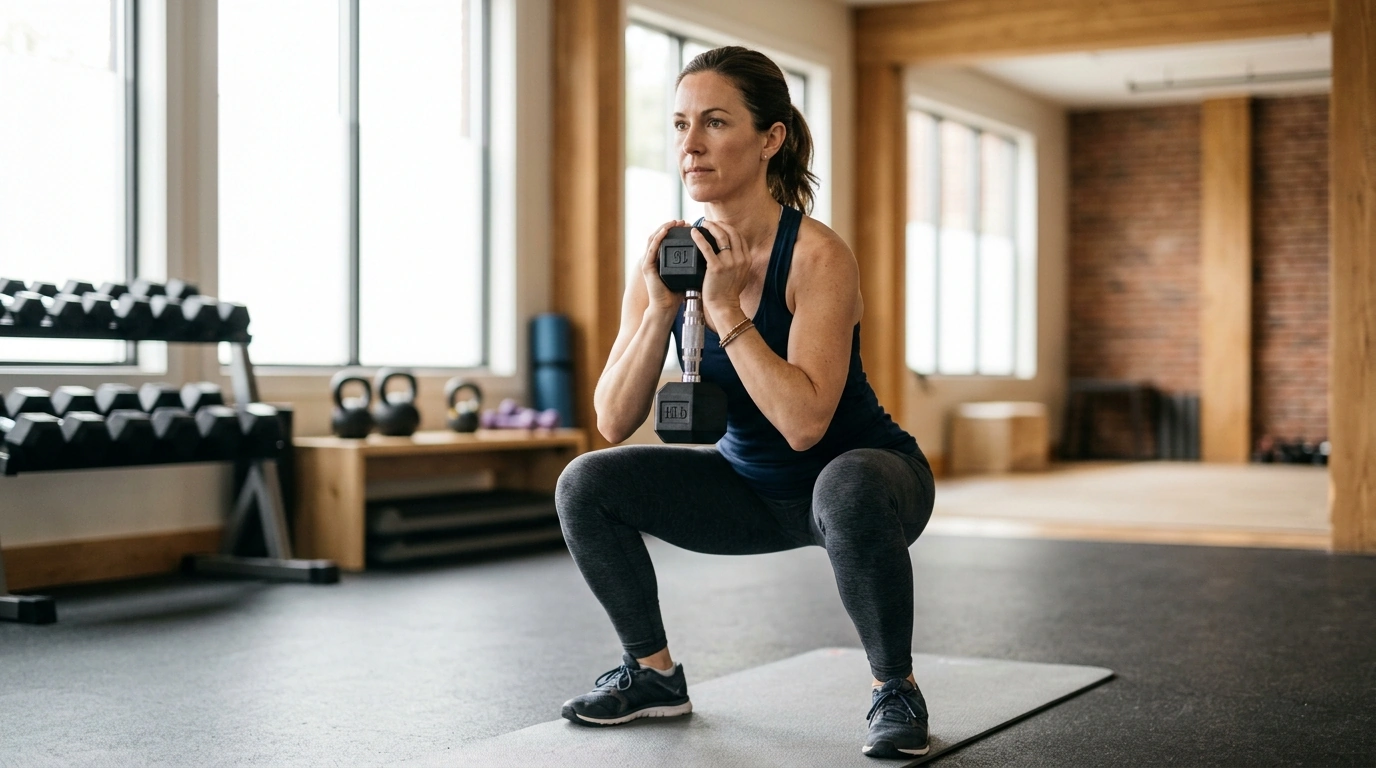
| 1 | Squat | Goblet squat, leg press | 2–3 sets of 8–10 reps |
| 2 | Hinge | Romanian deadlift, hip hinge with dumbbells | 2–3 sets of 8–10 reps |
| 3 | Push | Dumbbell bench, incline press, push-ups | 2–3 sets of 6–10 reps |
| 4 | Pull | Lat pulldown, cable row, one-arm row | 2–3 sets of 8–12 reps |
| 5 | Core/Carry | Pallof press, dead bug, farmer carry | 2–3 sets (time or reps) |
Progress Without Overthinking: The Beginner Progression Rules
Progression is where most beginners either stall (no plan) or burn out (too much, too fast). Use this priority order: form first, then reps, then weight.
- Use a rep range: for example, 6–10 or 8–12.
- When you hit the top of the range on all sets with clean reps, increase weight next time.
- Make small jumps: modest plate or dumbbell increases help you keep good mechanics.
- Track only what matters: exercise, weight, reps, and a quick “easy/medium/hard” note.
- Deload when needed: if sleep, stress, or soreness is high, repeat loads rather than forcing increases.
Form, Safety, and Gym Confidence (The Stuff That Usually Isn’t Explained)
Equipment and Substitutions (So You Can Train Anywhere)
Recovery and Nutrition Basics That Support Strength
How to Use the Digital Download for Real Results (Not Just a One-Time Read)
Recommended Digital Downloads (In Stock)
- Lift Strong, Start Confident – The Ultimate Guide on How to Start Weightlifting for Women | Beginner-Friendly Digital Download
- AI for Small Business Toolkit – 5-in-1 Digital Download Bundle
FAQ
How many days per week should a beginner woman lift weights?
Start with 2–3 strength days per week so you have enough recovery while still practicing the movements often. Pick one schedule you can maintain and stick with it for four weeks before making changes.
Should beginners start with dumbbells, machines, or barbells?
All three can work, but dumbbells and machines often feel easiest to learn because they’re adjustable and more forgiving. Barbells can be a great option too when you keep loads lighter and prioritize controlled reps and solid technique.
How do I know when to increase the weight?
Use a rep range and progress with form first: when you can hit the top of the range on all sets with control and no pain, increase the load slightly next session. If your sleep or soreness is off, repeat the same weight and focus on cleaner reps.
Recommended for you


Stripe or Square: Which Is Cheaper to Use?
Oct 8, 2026
Dress Smart for Every Shape: Easy Outfit System
Oct 9, 2026













Leave a comment