-
Shop
- Advanced Technologies
- AI Skills
- Bathroom
- Best-Sellers
- Car Accessories
- Confidence
- Dating & Social Skills
- Digital Resources
- AI & Technology
- Beauty
- Budgeting & Saving
- Car Buying & Ownership
- Cozy Feast Collection
- Electronics & Technology
- Entrepreneurship & Business Growth
- Financial Education
- Financial Independence
- Financial Mindset & Psychology
- Goal Setting
- Home Styling & Organization
- Kitchen & Recipes
- Leadership
- Mindfulness
- Mindset
- Online Business
- Parenting & Child Development
- Personal Style & Fashion
- Pet Lifestyle & Wellness
- Positive Thinking
- Sleep Improvement
- Smart Life with AI
- Stress Management & Relaxation
- Travel Planning
- Wellness
- Yoga & Fitness
- Yoga & Mind-Body Practices
- Education & Learning
- Family & Parenting
- Fashion
- Accessories
- Alexander McQueen
- Bags
- Bags & Wallets
- Balenciaga
- Belts
- Blazers
- Bottega Veneta
- Bottoms
- Brunello Cucinelli
- Burberry
- Chanel
- Chloé
- Dior
- Dolce & Gabbana
- Dresses
- Etro
- Fendi
- Gucci
- Hats & Hair Accessories
- Hoodies & Sweatshirts
- Jacquemus
- Jewelry
- Jil Sander
- Kiton
- Luggage
- Miu Miu
- Off-White
- Outerwear
- Prada
- Rick Owens
- Saint Laurent
- Shoes
- Socks & Tights
- Sweaters & Cardigans
- The Row
- Tom Ford
- Tops & Shirts
- Valentino
- Valentino Garavani
- Versace
- Vivienne Westwood
- Watches
- Fashion Accessories
- Furniture
- Gadgets
- Health & Beauty
- Health & Wellness
- Home & Garden
- Home Decor
- Home Electronics
- Home Supplies
- Kids & Babies
- Kitchen
- Kitchen Best-Sellers
- Lighting
- Patio, Lawn & Garden
- Personal Growth
- Pet Care
- Pet Supplies
- Pets
- Sport & Outdoors
- Super Deals
- Travel
- Travel & Adventure
- Wealth
- Popular
- Best deals
12-Season Color Analysis Guide: Build a Flattering Palette

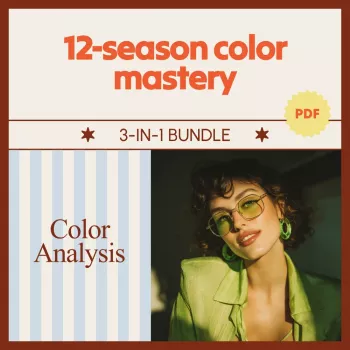
12-Season Color Mastery Blueprint: a clearer path to colors that actually match
A 12-season color system adds nuance beyond the classic four-season approach, helping match clothing, makeup, and accessories to undertone, value, and chroma. The goal is simple: fewer “close but not quite” purchases and more outfits that look intentional. The 12-Season Color Mastery Blueprint | 12 season color analysis 4-in-1 Color Guide Bundle is designed for people who want a structured way to narrow down their season and translate it into practical, repeatable styling choices—whether you’re decluttering a closet, building a capsule, or trying to stop guessing in fitting rooms.
What a 12-season color system changes (beyond the 4 seasons)
The traditional seasonal method groups people into Spring, Summer, Autumn, or Winter. The 12-season approach keeps that foundation, but breaks each season into three more specific sub-seasons—so your palette fits your natural coloring with better precision.
- More accuracy through sub-seasons: Each core season splits into three “neighbors,” which helps when you don’t fully match the textbook version of a season.
- Three core levers explain the “why”: Undertone (warm/cool), value (light/deep), and chroma (soft/bright) clarify why one blue makes you glow while another looks off.
- Borderline cases become easier: Instead of feeling stuck between two categories, the system differentiates warm-but-soft vs. warm-and-bright (and similar combinations).
- Wardrobes get more cohesive: When neutrals, accents, metals, and prints follow the same rules, outfits coordinate with less effort.
For a deeper background on how humans perceive color and why certain combinations appear more harmonious, resources like Color Matters and the Britannica overview of color offer helpful context.
What’s inside the 12-Season Color Mastery Blueprint 4-in-1 bundle
This bundle is built to function like a practical reference you can return to—especially when shopping online, comparing swatches, or planning outfits quickly.
- A blueprint-style framework: A step-by-step structure to guide season identification and better decision-making.
- Multiple wearable color guides: Palettes that translate a season into outfit-friendly colors—so you can use the system, not just understand it.
- Cross-category consistency: Reference-style sections that support choices across clothing, hair, makeup, jewelry, and eyewear.
- Quick lookups: Designed to be easy to scan while decluttering, packing, or adding pieces to a capsule wardrobe.
How each part supports real-world styling decisions
| Bundle component | Best used for | Practical outcome |
|---|---|---|
| Season identification framework | Narrowing down undertone, value, and chroma | Fewer mismatched purchases and more consistent color choices |
| Season palette guides | Choosing clothing colors and coordinating outfits | Outfits look more harmonious with less effort |
| Neutral + accent pairing references | Building capsules and travel wardrobes | More combinations from fewer items |
| Accessory and beauty guidance | Metals, makeup tones, and finishing touches | A polished look that matches the palette rather than fighting it |
A simple workflow: from analysis to a wearable wardrobe
Color analysis can feel abstract until it’s connected to everyday decisions. This workflow keeps it grounded, using comparisons that are easy to repeat.
- Identify baseline temperature (warm/cool): Compare how your skin reacts to gold vs. silver jewelry, and test warm vs. cool whites near the face in natural light.
- Determine value (light vs. deep): Notice whether very light colors reduce under-eye shadows and soften contrast, or whether deeper shades look more balanced and defined.
- Determine chroma (soft vs. bright): Compare muted, dusty tones against clear, saturated tones. The right chroma makes features look more even and “finished.”
- Map results to a 12-season family: Confirm with a short list of best colors and avoid colors, tested close to the face.
- Build a starter capsule: Choose 2–3 neutrals, 3–5 core colors, 2–3 accents, plus a metal direction for jewelry hardware.
If you like referencing standardized color naming when shopping (especially online), exploring the Pantone Color Institute can help you describe shades more consistently.
Common sticking points and how the 12-season approach helps
- Olive or neutral-leaning undertones: Rely on multiple cues—metals, whites, and lip/cheek tones—rather than a single “test” that can be misleading.
- Dyed hair or tanning: Anchor decisions in how colors behave next to the skin near your face, not hair labels like “blonde” or “brunette.”
- High contrast vs. low contrast: In many real wardrobes, value and chroma drive cohesion even more than temperature.
- Makeup confusion: When clothing tests feel ambiguous, aligning blush and lipstick to a season can make undertone direction more obvious.
Season-to-shopping translation: quick rules that prevent mistakes
Who benefits most from this bundle
Product details and availability
Primary guide: 12-Season Color Mastery Blueprint | 12 season color analysis 4-in-1 Color Guide Bundle
Format: Digital guide bundle focused on 12-season color analysis and practical palette use
Price: 267.99 USD
Availability: In stock
More in-stock digital bundles
- AI for Small Business Toolkit – 5-in-1 Digital Download Bundle
- Choosing the Right Payment Solution for Your Business: Stripe vs Square Which Is Better – Complete eBook Guide for Small Business Owners
FAQ
What is the most rare color analysis season?
Rarity claims vary by region and the specific methodology used, so there isn’t a single universally “rarest” season. Accurate identification matters more than rarity, and some sub-seasons are simply reported less often depending on the analyst’s system and the population sampled.
How do I determine my season color analysis?
Use three variables: undertone (warm/cool), value (light/deep), and chroma (soft/bright). Try simple at-home comparisons like gold vs. silver, warm vs. cool whites, and muted vs. bright colors, then confirm by testing a short list of best and worst shades near your face in natural light.
What are the 4 seasons of color analysis?
The four seasons are Spring, Summer, Autumn, and Winter. Spring and Autumn tend to lean warm, while Summer and Winter tend to lean cool; 12-season systems subdivide these to capture more precise combinations of value and chroma.











Leave a comment