-
Shop
- Advanced Technologies
- AI Skills
- Bathroom
- Best-Sellers
- Car Accessories
- Confidence
- Dating & Social Skills
- Digital Resources
- AI & Technology
- Beauty
- Budgeting & Saving
- Car Buying & Ownership
- Cozy Feast Collection
- Electronics & Technology
- Entrepreneurship & Business Growth
- Financial Education
- Financial Independence
- Financial Mindset & Psychology
- Goal Setting
- Home Styling & Organization
- Kitchen & Recipes
- Leadership
- Mindfulness
- Mindset
- Online Business
- Parenting & Child Development
- Personal Style & Fashion
- Pet Lifestyle & Wellness
- Positive Thinking
- Sleep Improvement
- Smart Life with AI
- Stress Management & Relaxation
- Travel Planning
- Wellness
- Yoga & Fitness
- Yoga & Mind-Body Practices
- Education & Learning
- Family & Parenting
- Fashion
- Accessories
- Alexander McQueen
- Bags
- Bags & Wallets
- Balenciaga
- Belts
- Blazers
- Bottega Veneta
- Bottoms
- Brunello Cucinelli
- Burberry
- Chanel
- Chloé
- Dior
- Dolce & Gabbana
- Dresses
- Etro
- Fendi
- Gucci
- Hats & Hair Accessories
- Hoodies & Sweatshirts
- Jacquemus
- Jewelry
- Jil Sander
- Kiton
- Luggage
- Miu Miu
- Off-White
- Outerwear
- Prada
- Rick Owens
- Saint Laurent
- Shoes
- Socks & Tights
- Sweaters & Cardigans
- The Row
- Tom Ford
- Tops & Shirts
- Valentino
- Valentino Garavani
- Versace
- Vivienne Westwood
- Watches
- Fashion Accessories
- Furniture
- Gadgets
- Health & Beauty
- Health & Wellness
- Home & Garden
- Home Decor
- Home Electronics
- Home Supplies
- Kids & Babies
- Kitchen
- Kitchen Best-Sellers
- Lighting
- Patio, Lawn & Garden
- Personal Growth
- Pet Care
- Pet Supplies
- Pets
- Sport & Outdoors
- Super Deals
- Travel
- Travel & Adventure
- Wealth
- Popular
- Best deals
Fear of Judgment: 10-Min Checklist to Speak Up
What fear of judgment looks like in real life
Fear of judgment isn’t only a big “stage fright” moment. It shows up in everyday micro-decisions that quietly shape how much space a person takes up.
- Overthinking simple interactions: rewriting messages, replaying conversations, delaying replies
- Staying quiet in groups despite having something useful to say
- People-pleasing habits: agreeing too quickly, avoiding disagreement, apologizing excessively
- Physical stress signals: tight chest, shaky voice, racing thoughts, flushed face
- A loop that reinforces itself: avoidance reduces anxiety short-term but increases fear long-term
The tricky part is how “reasonable” it can feel. The mind calls it being careful, polite, or strategic—until it becomes a pattern of shrinking, second-guessing, and waiting for the perfect moment that never arrives.
Why the brain treats social judgment like a threat
Social evaluation can register in the body as danger, even when the stakes are low. That’s not weakness—it’s biology. Stress responses are built to protect, and social belonging has long been linked to safety and survival.
- Social belonging is wired as a safety signal; perceived rejection can trigger a stress response
- The mind overestimates consequences (“If I’m awkward, it will be a disaster”) and underestimates coping ability
- Spotlight effect: feeling more noticed than reality (most people are focused on themselves)
- Perfectionism and mind-reading amplify uncertainty and raise the bar to an unrealistic level
When stress is running the show, the body can flood with adrenaline—racing heart, shallow breath, narrowed attention. The American Psychological Association explains how stress affects the body, and those same effects can make it harder to think clearly in social moments. If fear of evaluation feels persistent and intense, it can overlap with social anxiety patterns described by the National Institute of Mental Health.
The Survival Checklist: a repeatable 10-minute routine
This routine is meant to be fast, repeatable, and forgiving—more like a pre-flight check than a deep analysis. Use it before a meeting, a tough text, a boundary, or a post. The goal isn’t to erase anxiety; it’s to move while it’s there.
Step 1 — Name the moment
Identify the situation and the feared outcome in one sentence: “I need to say X, and I’m afraid they’ll think Y.” Naming it reduces the vague dread.
Step 2 — Regulate first
Before speaking, lower the adrenaline. Try a short breath cycle (inhale 4 seconds, exhale 6 seconds for 5 rounds) or a grounding cue (press feet into the floor, soften shoulders).
Step 3 — Reality-check the story
Separate facts from guesses. Facts: what is known. Guesses: what is assumed. This stops mind-reading from driving the plan.
Step 4 — Choose a “good enough” goal
Aim for clarity, not perfection. Pick one point to communicate. If the mind wants five disclaimers, return to the single point.
Step 5 — Write a one-line opener
Draft a simple first sentence that starts the action. An opener is a bridge—once you say it, momentum helps carry you.
Step 6 — Run the 30-second courage plan
If anxiety spikes mid-sentence, pause, take one slow breath, and continue. No explaining the pause. A calm restart looks confident even when it’s a coping tool.
Step 7 — Close cleanly
End with a question, request, or next step rather than extra justification. Over-explaining often comes from trying to manage impressions.
Step 8 — Debrief kindly
Write: what worked, what to tweak, and one win. Keep it brief. No post-mortem spiral.
Quick-reference checklist for common moments
| Situation | What to say (starter line) | Small brave action | After-action reset |
|---|---|---|---|
| Meeting or class discussion | “I’d like to add one point…” | Share one sentence, then stop | Write 1 thing that went fine |
| Setting a boundary | “I’m not able to do that, but I can…” | Offer one alternative or a clear no | Stand up, stretch, breathe out slowly |
| Giving feedback | “Can I share a quick observation?” | Use one example + one request | Drink water, release shoulders |
| Posting online | “Here’s what helped me…” | Post, then log off for 10 minutes | No comment-checking during the timer |
Build confidence through tiny reps (not big personality changes)
Confidence grows less from “becoming fearless” and more from proving—repeatedly—that discomfort is survivable. The smallest reps count because they train the nervous system to recover.
- Use “exposure ladders”: start with low-stakes actions and gradually increase difficulty
- Track consistency, not outcomes: a rep counts even if it felt awkward
- Swap “How did I look?” for “Did I act according to my values?”
- Practice neutral body cues: feet grounded, slower exhale, relaxed jaw, steady pace
- Create scripts for predictable moments: introductions, disagreement, asking for help
A practical ladder might start with asking one clarifying question per meeting, then offering one suggestion, then disagreeing respectfully once a week. The win is showing up—especially when the brain urges you to hide.
Speak up without overthinking: practical language tools
When fear of judgment is persistent or overwhelming
Digital checklist details and how to use it daily
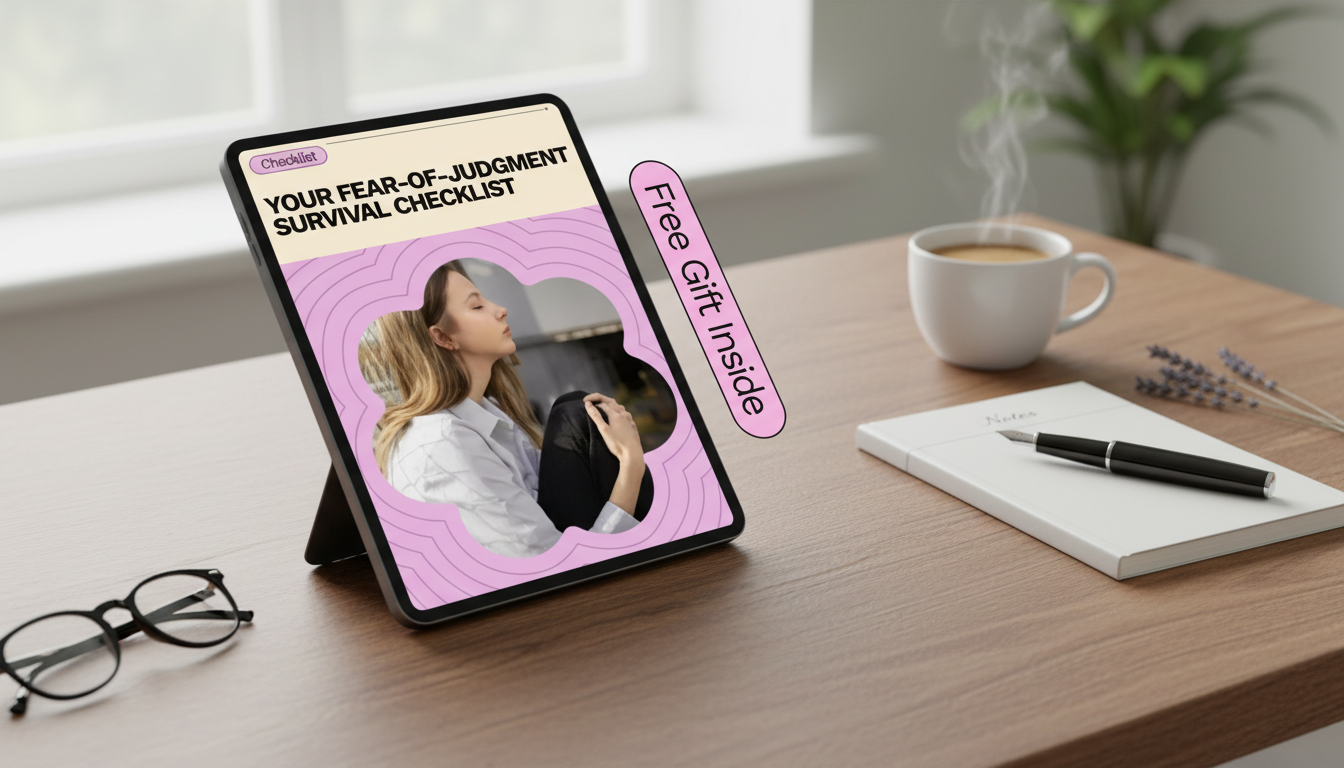
For moments when your mind starts rehearsing and your body starts bracing, a simple “open-and-go” tool can interrupt the loop. Your Fear-of-Judgment Survival Checklist (digital download) is designed for quick access—before a meeting, conversation, post, or boundary-setting moment.
If speaking up is tied to running a team, serving clients, or making decisions faster, pairing confidence tools with systems can reduce decision fatigue. The AI for Small Business Toolkit – 5-in-1 Digital Download Bundle can support clearer workflows—so you spend less time second-guessing and more time taking action.
FAQ
How to be yourself without fear of judgement?
Focus on acting from values instead of managing impressions: name the fear, regulate your body, choose one honest sentence, and measure success by showing up—not by others’ reactions.















Leave a comment